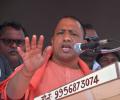
Adityanath called for an end to the Muslim practice of 'triple talaq' and advocated implementation of a common civil code in the country.

'Worryingly, intelligence assessments indicate that growing disaffection amongst the youth is ceding ground to fundamentalist Islamist groups like Islamic State,' reports Ajai Shukla.

A lot of the terrorism that is affecting Pakistan is really a blowback of the Pakistani state's policy of using jihadist groups as instruments of state policy. And unlike some other countries with similar policies, Pakistan doesn't have the benefit of the political and social space for pulling back from the disastrous course, says Sushant Sareen.
Indians must remember that Pakistanis hate losing to India, at war or in cricket, says Sanjeev Nayyar.

The US and its allies must evolve a more comprehensive long-term plan to defeat the new danger that the caliphate poses to the world order. And India too must do its bit for course correction, says strategic expert Gurmeet Kanwal.
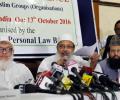
When the Muslim Personal Law Board promises 'advisories' and nikahnamas to the Supreme Court, one has to remember not only its recent campaign against any change in Muslim personal law, but also its past record of inaction on the question of triple talaq, says Jyoti Punwani.

Dr Behera speaks about how the nationwide positive reaction to the abrogation of Article 370 in Jammu and Kashmir indicates that the very idea of India is changing. From a diverse, multicultural entity, could India be becoming a place where assimilation is more important than accommodation?

The Saudi-Pakistan nuclear weapons cooperation is meant to sound alarm bells in Washington, reminding the Obama administration that its overtures to Iran would have serious negative consequences in terms of its ties with its closest allies in the region, says Ambassador Talmiz Ahmad. Exclusive to Rediff.com
Authorities said social media posts will be monitored to ensure that no attempt is made to vitiate the atmosphere.

The attack on the Balochistan Police College, 20 km from Quetta city began around 11:10 pm on Monday night, triggering an operation by Pakistani security forces who rescued hundreds of cadets from the academy.
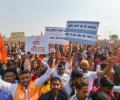
The judgment in the matter is to be pronounced by November 17, the day the CJI will retire.

In any institution that has a passionate ideology, the moderate is always vulnerable to the person who is more extreme, because that is what the supporters want.

'If the charges are so serious against him, then why hasn't a single case been registered against Dr Zakir Naik?'

'What needs to be pursued as the operations progress is a degree of reconciliation amongst the other parties, less the more orthodox Al Qaeda affiliates.'

The apex court said the parties in the matter should be ready to start the hearing on the appeals which are before it.
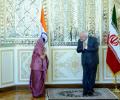
India's low passion, very cautious, relationship with Iran of the last 36 years awaits transformation, says Lieutenant General Syed Ata Hasnain (retd). Prime Minister Modi's visit cannot be a negotiating event; it is a symbolic one to strengthen the politico-diplomatic relationship.

'Pakistan is full of 'religious entrepreneurs' like Hafeez Saeed who poison the minds of the young so that they can be motivated to become terrorists. They work in concert with the rulers of Pakistan. It is a private-public partnership.'
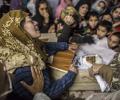
'Pakistan is paying the price for ignoring secularism. In seeking to be ever more Muslim to define its nationhood, it has become a terrorist haven.'

Awful religious practices need to be abolished. But through social and political reformers, not by courts, argues Shekhar Gupta.

Iranian President Dr Hassan Rouhani Tuesday talked about the greater need for South-South cooperation, an issue closer to India's heart and expected to be addressed by Prime Minister Dr Manmohan Singh during his speech at the United Nations General Assembly this Saturday.
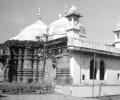
Contemporary records speak of Chhatrapati Shivaji's resolve to liberate Hindu holy places, and the later Maratha rulers carried forward his legacy, Colonel Anil A Athale (retd) reveals in a forthcoming book.

In order to formulate a Uniform Civil Code, the Law Commission has sent out of list of 16 questions to gauge public opinion,
Pakistan faces a challenge largely of its own creation and only political processes can correct it, argues Raza Rumi.

Colonel Anil Athale (retd) recalls how the Battle of Panipat, 258 years ago, changed the history of India for the next century and half.

The main culprit in vitiating the inter community/caste/class relations has been the so called 'targeted' approach. This is nothing but discrimination on the basis of faith/caste/class. When an equally poor and deprived child is denied scholarship, despite equal merit, resentment begins to brew, says Colonel (retd) Anil Athale.

Unlike Al Qaeda, ISIS recruiters are proactive and internet savvy. They know there is angst among Muslims about their helplessness even in a vibrant democracy like India, leave alone other parts of the world where Muslims live. So ISIS feeds them a regular diet of the golden age of the Ummah, creating for these youngsters a live yet make-believe world which is completely disconnected from the reality around them, says Syed Firdaus Ashraf.

If you are more than your rhetoric about a strong and united country, give us our due -- treat us as countrymen, says an ordinary Muslim in this open letter.

The government's leaks to the media and General Singh's very vocal comments on the charges against him have played right into the hands of separatists and their cross-border sponsors, says Nitin Pai

Two Taliban suicide bombers struck a historic church in Peshawar Sunday, killing at least 78 people, including women and children, in the deadliest attack on the minority Christian community in Pakistan's history.

'As matters stand, Russia and Saudi Arabia, two of the world's biggest oil producers, are set for a hard landing as they didn't diversify their economies as much as they should have when the oil prices were booming.'

Shankar Acharya gives ten predictions on key politico-economic developments in the world and ten for India.

One has to wonder what is so wrong with the European Union.

'The BJP is not the party it was 10 years ago. It has changed. It is emerging like the Congress.' 'Sometimes, I feel the BJP has taken the Congress' space.' 'Its politics is also resembling the Congress.'

Sanjeev Nayyar suggests 16 measures by which we can tackle our unrelenting and untrustworthy neighbour.

The US #DeepState has had a fine run, but will now discard Saudi Arabia as it is no longer useful to them, says Rajeev Srinivasan.

Its promise has fallen short before the onslaught of the votaries of the old order and ruthless extremist forces, notes Talmiz Ahmad.
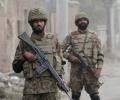
India must watch for signs after Peshawar that Pakistan is waking up to the dangers of Islamism, muses Ajai Shukla

While Iraq and Afghanistan top the Global Terrorism Index 2014 as the most terror-affected nations, India has been ranked number six.

The ninth edition of the Global Peace Index, which ranks the nations of the world according to their level of peacefulness, has ranked Syria as the most dangerous country in the world.

'The parallels between 1914 and 2014 are striking. The crumbling of American and Russian hegemony, the rise of powerful terrorist groups, ferment in the Middle East and the rise of China... These closely mirror the world of 1914,' says Colonel Anil A Athale (retd).
 © 2026 Rediff.com - Advertise with us - Disclaimer - Privacy Policy - Sitemap - Feedback - About us - Terms of use - Grievances